Microsoft Deploys Configuration Patch to Stabilize Global Microsoft 365 Outage
Microsoft is gradually stabilizing its cloud infrastructure after an internal capacity cascade knocked carious Microsoft 365 services offline worldwide, forcing hospitals, emergency services, and enterprises onto manual backups while IT admins await full service restoration and audit delayed mail and security alerts.

Key Takeaways:
- An overwhelmed backend process triggered cascading server failures that took Microsoft 365 services offline worldwide.
- Microsoft deployed an upstream authentication and routing patch to stabilize servers.
- Admins should avoid changing local DNS or Outlook profiles during recovery.
Microsoft says its cloud infrastructure is finally beginning to stabilize after a major service outage affected Exchange Online, Microsoft Teams, Microsoft 365 Copilot, and core administrative tools offline worldwide. Microsoft’s engineers rolled out a targeted configuration update to keep critical workloads online following hours of recovery attempts where restarted servers repeatedly crashed under live traffic.
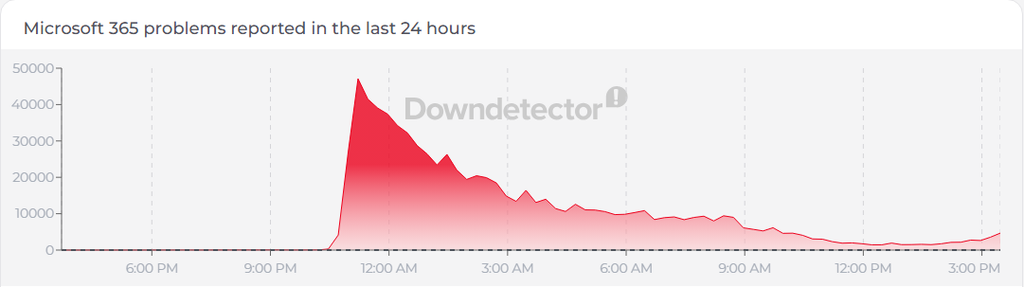
This incident began around 11:17 a.m. ET (16:17 UTC) on Thursday, November 12, 2026. An overwhelmed core process caused servers to fail automated health checks and drop out of rotation, which created a cascading capacity degradation. Microsoft Outlook, Teams, SharePoint, Copilot, Intune, and Defender XDR suffered widespread disruptions across enterprises, healthcare trusts, and emergency services. A patch for an upstream authentication and routing component is improving server stability, and Microsoft says there is no sign of a cyberattack.
What went down?
This incident had a major impact on Microsoft Outlook, with Downdetector logging more than 130,000 user reports at the peak of the disruption. The outage quickly spread across other tools. These include Exchange Online, Outlook.com, Microsoft Teams, SharePoint Online, OneDrive, OneNote, Planner, and Microsoft To Do, Microsoft 365 Copilot, Defender XDR, Defender for Office 365, and Microsoft Purview, Microsoft Intune, the Microsoft 365 Apps Admin Center, Universal Print, and Windows 365 Cloud PCs using Purview Customer Key.
Consequently, several UK National Health Service (NHS) trusts and regional police forces had to fall back on phone lines for urgent public inquiries while internal email and web forms were dark. Trading desks and logistics operators were similarly forced back onto phones and manual spreadsheets to keep orders moving across Europe and Asia.
Why initial fixes didn’t work?
Microsoft confirmed this outage wasn’t caused by an external surge in user demand. Instead, a core process on backend servers became overwhelmed, which affected automated health checks and pulled those machines out of service. This issue left fewer nodes to carry the load, which pushed surviving servers past their limits.
According to Microsoft, early efforts on Thursday afternoon and evening to reboot servers and shift traffic to alternate routes offered only brief relief. Every time engineers brought nodes back into rotation, live user traffic overwhelmed them again. To address this issue, Microsoft froze non-essential service changes, throttled certain types of incoming traffic, and focused on patching an upstream authentication and routing component.
Current status and admin guidance
On Friday, November 13, Microsoft stated that its recovery efforts are showing “incremental improvement,” though its services have not yet fully recovered.
“Recovery actions are ongoing and have progressed in phases across affected Microsoft 365 infrastructure. Global telemetry and customer reports show incremental improvement in several workloads; however, service health remains variable and capacity has not yet fully returned to baseline. Network and traffic-management actions remain active. To protect email during recovery, we’re continuing to prioritize queue and backlog processing, and the email timeout window has been extended to 48 hours to preserve delayed messages,” Microsoft explained.
For IT admins, it’s recommended to avoid rebuilding Outlook profiles, change local DNS records, or tweak tenant routing rules while Microsoft finishes bringing regions back online. Keep an eye on Health > Service health in the Microsoft 365 Admin Center for tenant-specific updates, and then audit queued mail flow, delayed Microsoft Defender alerts, and pending Intune policy syncs.

Rabia has a master's degree in Software Engineering and she has years of experience writing professionally about Microsoft products and other technologies. Rabia has also written for OnMSFT.com as well as Windows Report. She is always up to date on t...