Why Microsoft Copilot Adoption Is Lagging: The ROI Dilemma
The real ROI might not neatly fit into your quarterly report, but it could still be very real.

Businesses everywhere are scrutinizing every new tech expense and Microsoft’s AI-powered Copilot is no exception. Despite the hype around artificial intelligence transforming the workplace, many organizations are pressing pause on rolling out Microsoft 365 Copilot to all their employees.
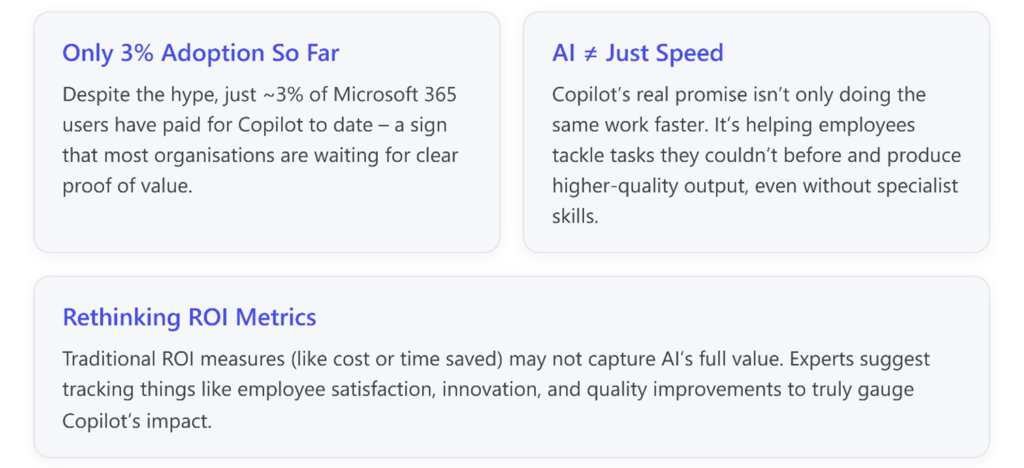
In fact, Microsoft recently revealed that only about 3% of Microsoft 365 users have chosen to pay for Copilot so far. Considering Microsoft 365 has roughly 450 million commercial users, that translates to just 15 million paying Copilot customers.
This hesitant adoption comes down to one thing: return on investment (ROI). Simply put, companies are holding back on Copilot because they’re not yet convinced it will boost productivity enough to justify the $30-per-user monthly price tag. But focusing only on short-term productivity might mean missing the bigger picture of what AI assistants can do.
The productivity proof paradox
Many companies have been sold on the promise of AI boosting productivity, yet they’re not seeing an obvious, immediate productivity spike from Copilot and that makes budget holders nervous. Microsoft’s Jared Spataro, who leads the Modern Work & Business Applications group, admitted that even when Copilot improves efficiency by 20–30% in tests, connecting that to tangible ROI is tricky. In traditional manufacturing or sales roles, output and revenue gains are easier to measure. But in knowledge work, being “30% more productive” doesn’t automatically show up on the bottom line. If an engineer writes a report faster, it doesn’t directly create 30% more profit.
The productivity paradox means IT and finance leaders are cautious. They’re asking: Where are the hard numbers? Until they see clear evidence that Copilot saves time and money in their specific workflows, many will continue to run limited trials rather than organization-wide rollouts.
Adding to the hesitation is the context of 2025–2026’s AI gold rush and investor skepticism. Tech companies (Microsoft included) have poured billions into AI, touting it as the next big productivity revolution. But when only a sliver of users convert to paying customers, it undercuts the success story. Some leaders worry about jumping on an expensive bandwagon that might not live up to the revenue and efficiency hype. In this climate of caution, the bar for proof is high: CEOs and CIOs want to see measurable productivity gains or cost savings before they commit to Copilot at scale.
Beyond productivity: What else Copilot brings
Focusing solely on productivity ROI might be missing the forest for the trees. Yes, Copilot can automate tasks and potentially save minutes or hours each day. For instance, early adopters like Lloyds Banking Group claimed Copilot saved their staff nearly 46 minutes daily on routine tasks.
But the true value of AI assistants isn’t just about doing the same work faster. It’s also about doing things that weren’t possible before, and doing them better.
Think about it in practical, everyday terms. Copilot can act as a “force multiplier” for employees’ skills. A marketing specialist with no graphic design training can suddenly create a decent infographic or slide deck with a bit of AI help. Something that might have required a dedicated designer before.
A junior analyst can use Copilot to write a first draft of a report or crunch numbers in Excel, even without expert spreadsheet skills. In a very real sense, Copilot democratises capabilities across disciplines, meaning employees can tackle tasks they wouldn’t have dared to try previously, unlocking new potential and creativity on the team.
Equally important is the quality of work. Used thoughtfully, AI can help improve the polish and clarity of output. For example, Copilot can suggest clearer wording in an email or generate a thorough outline for a complex proposal. It’s like giving each employee an on-demand assistant or editor.
The result isn’t just faster work, but often higher-quality work products from people who aren’t specialists in those areas. Of course, there’s a learning curve. Using AI effectively requires training and effort, and poorly managed AI can produce “sloppy” results. But when organizations invest in upskilling their staff to work with AI (and set guidelines to avoid garbage in/garbage out), they can benefit from both productivity and quality gains.
Rethinking ROI: From satisfaction to innovation
So, if not by raw productivity alone, how should we measure Copilot’s ROI? Forward-thinking leaders and analysts suggest expanding the definition of “return.” One compelling idea is to look at Return on Experience: essentially, employee satisfaction and engagement.
Copilot and job satisfaction
If Copilot can take away drudge work and reduce after-hours toil, it can make employees’ day-to-day jobs more satisfying. Happier employees tend to stay longer and perform better. In fact, reducing burnout and turnover has a clear dollar value. One study estimated the average cost of replacing an employee at over £30,000 in lost productivity and hiring costs. If Copilot helps keep your team happier and less likely to quit by easing their workload, those savings and morale boosts are part of the ROI, even if they’re not immediately visible on a spreadsheet.
Copilot Return on Output
Another angle is what some call Return on Output or innovation capacity. What new outputs and innovations are made possible because of Copilot? Maybe your customer support team uses AI to create a new knowledge base, saving future service costs. Or your sales team uses Copilot to analyze CRM data and discovers a new market opportunity.
These are qualitative gains. I.e. new projects, better decisions, innovative ideas that stem from having a smart assistant on hand. Microsoft’s own commissioned research found that some businesses credit Copilot for speeding up time-to-market for new products and increasing their agility to compete. It’s not just about doing the same work faster, but achieving things that drive the business forward.
Copilot and traditional metrics
And yes, we shouldn’t ignore traditional metrics like cost savings but we should broaden them. Copilot might not always let you cut headcount (nor should that be the goal), but it could reallocate human effort to more valuable activities. Maybe you don’t need as many outsourced contractors because your in-house team can handle more with AI assistance.
Maybe projects wrap up with fewer costly overruns. Some early data shows small businesses using Copilot saw operational cost reductions on the order of 10–20%. These cost savings, combined with the less tangible benefits above, contribute to a much more promising picture of ROI than productivity stats alone.
Conclusion: The case for a broader view
Organizations reluctant to deploy Copilot at scale have valid concerns. No one wants to spend money on a technology without clear payback. However, insisting on immediate, simplistic ROI (like “hours saved per employee per day”) might underestimate what AI tools actually offer.
The true value of Copilot can encompass productivity, yes, but also skills democratization, quality improvement, employee happiness, innovation speed, and cost optimization. To capture those, companies need to update how they measure success. Some experts suggest new lenses like experience, output, and decision-making to supplement classic ROI metrics.
In practice, this means IT and business leaders should identify where they expect Copilot to make a difference, whether it’s reducing burnout, sparking new ideas, improving customer outputs, or saving money and then track those outcomes.
Microsoft’s pitch is that Copilot is a long-term “strategic investment for growth,” not just a short-term efficiency tool. Early adopters are finding value in unexpected places, from faster innovation cycles to a better work-life balance for employees.
So, if you’re on the fence about rolling out Copilot, consider this: the real ROI might not neatly fit into your quarterly report, but it could still be very real. By broadening what “return on investment” means in the age of AI, organizations can make more informed decisions about when (and how) to embrace these powerful new tools.

Russell Smith, the Editorial Director at Petri IT Knowledgebase, has over two decades of hands-on experience in IT, in both small business settings and government IT infrastructure projects. Russell started writing for Windows IT Pro Magazine in t...