Windows Server Failover Clusters Now Support S2D and SAN Coexistence
A new Windows Server update allows S2D and SAN to operate together in a single failover cluster.

Key Takeaways:
- Microsoft now allows S2D and SAN to coexist in a single failover cluster for Windows Server 2022/2025.
- This hybrid setup offers flexibility, cost savings, and optimized workload placement.
- Organizations can mix high-performance S2D with resilient SAN for tiered storage and easier migration.
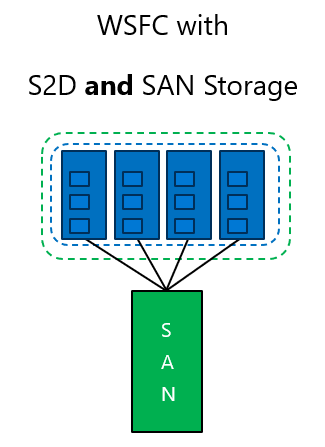
Microsoft has rolled out a new update that enables Storage Spaces Direct (S2D) and SAN storage to operate together within a single-rack failover cluster. This enhancement is available for Windows Server 2022 and Windows Server 2025.
Storage Spaces Direct (S2D) is a technology that enables hyperconverged infrastructure by pooling locally attached drives across cluster nodes to create high-performance, resilient storage without the need for shared hardware. In contrast, SAN (Storage Area Network) is a centralized storage solution that connects servers to shared disk arrays over a network. It offers advanced features like snapshots, replication, and enterprise-grade data protection.
Microsoft introduced this change to give organizations more flexibility and cost efficiency in managing storage. Many enterprises already have significant investments in SAN infrastructure but also want the performance benefits of S2D.
What are the benefits of a hybrid storage architecture?
The coexistence of S2D and SAN brings significant advantages for organizations who need a balanced storage strategy. It allows businesses to combine high-speed, cost-effective local storage with the advanced features and resilience of SAN, such as snapshots, deduplication, and robust backup options. This means workloads can be placed where they perform best, such as S2D for demanding, performance-sensitive applications and SAN for data protection and long-term storage.
According to Microsoft, this hybrid approach simplifies migration and scalability. Organizations can move workloads between S2D and SAN without downtime, adapt to changing requirements, and optimize resources without discarding existing investments. It’s a practical solution for enterprises embracing modern workloads like virtualization, AI, and analytics as well as maintaining reliability and security.
Important configuration guidelines for admins
Microsoft mentioned that admins should note a few implementation specifics that preserve reliability when mixing S2D and SAN in the same cluster. SAN-attached disks must never be added to the S2D storage pool, and S2D is designed to aggregate only Direct Attached Storage (DAS) devices discovered on the cluster nodes.
Additionally, formatting differs by storage type for Cluster Shared Volumes (CSV). SAN-backed CSVs must use NTFS, and S2D-backed CSVs should use ReFS (CSVFS_ReFS) to benefit from S2D’s performance and resiliency capabilities.
Practical use cases
Overall, coexistence of S2D and SAN opens doors to practical scenarios that go beyond AI and machine learning workloads. For example, organizations can use SAN for disaster recovery and long-term data retention and leverage S2D for high-performance compute tasks to create a resilient and cost-effective architecture.
Furthermore, it enables tiered storage strategies, where development and test environments run on S2D for speed, and production workloads remain on SAN for stability and compliance. Hybrid cloud integration with tools like Azure Arc becomes simpler, which allows phased migrations from legacy SAN systems to modern hyperconverged setups without disrupting operations.

Rabia has a master's degree in Software Engineering and she has years of experience writing professionally about Microsoft products and other technologies. Rabia has also written for OnMSFT.com as well as Windows Report. She is always up to date on t...