Ignite 2026: Microsoft Expands Windows Security Controls for an AI-Powered Enterprise
Microsoft is expanding Windows security with new protections for devices, identities, and AI agents. For enterprises, the updates could help standardize security controls across increasingly complex environments, though organizations will need new governance processes and stronger identity management to support AI-powered workflows.

Key Takeaways:
- Microsoft introduced new Windows security capabilities spanning endpoint protection, passwordless authentication, device management, and post-quantum cryptography.
- The company is positioning Microsoft Execution Containers as a governance framework for securing AI agents in enterprise environments.
- Organizations may need to modernize identity infrastructure, strengthen AI governance, and prepare for long-term cryptographic transitions.
As enterprises rush to deploy AI tools and autonomous agents, Microsoft is warning that attackers are moving just as quickly. AI is helping threat actors identify vulnerabilities, develop exploits, and scale attacks faster than traditional methods, which reduces the time organizations have to detect and remediate security weaknesses. At the same time, IT teams are being asked to secure users, devices, and applications, along with AI-powered agents that can access data and perform actions on behalf of employees.
At Microsoft Ignite 2026, Microsoft announced a new set of Windows security enhancements aimed at helping organizations address these challenges. These updates include endpoint protection, device resilience, passwordless authentication, management and recovery tools, post-quantum cryptography, and new governance controls for AI agents.
AI threats are raising the stakes for enterprise security
Microsoft argues that the rise of AI is increasing pressure on security teams to strengthen foundational protections. Organizations that fail to maintain secure configurations, current patches, and strong identity controls face a growing risk of compromise as attackers gain access to more sophisticated automation tools. Meanwhile, the introduction of AI agents creates an additional challenge because these systems can interact with applications, access resources, and take actions that were previously limited to human users.
This leads to a broader attack surface that extends beyond endpoints and accounts. Enterprises now need visibility and governance over how AI agents operate, what data they can access, and which actions they are permitted to perform. Without those controls, organizations risk creating new pathways for data exposure, privilege misuse, and compliance violations.
Microsoft expands Windows’ security foundation
To help organizations establish a stronger security baseline, Microsoft announced that the Windows endpoint security platform is now generally available on Windows 11. The platform is designed to reduce dependence on kernel-level drivers while maintaining compatibility with security solutions.
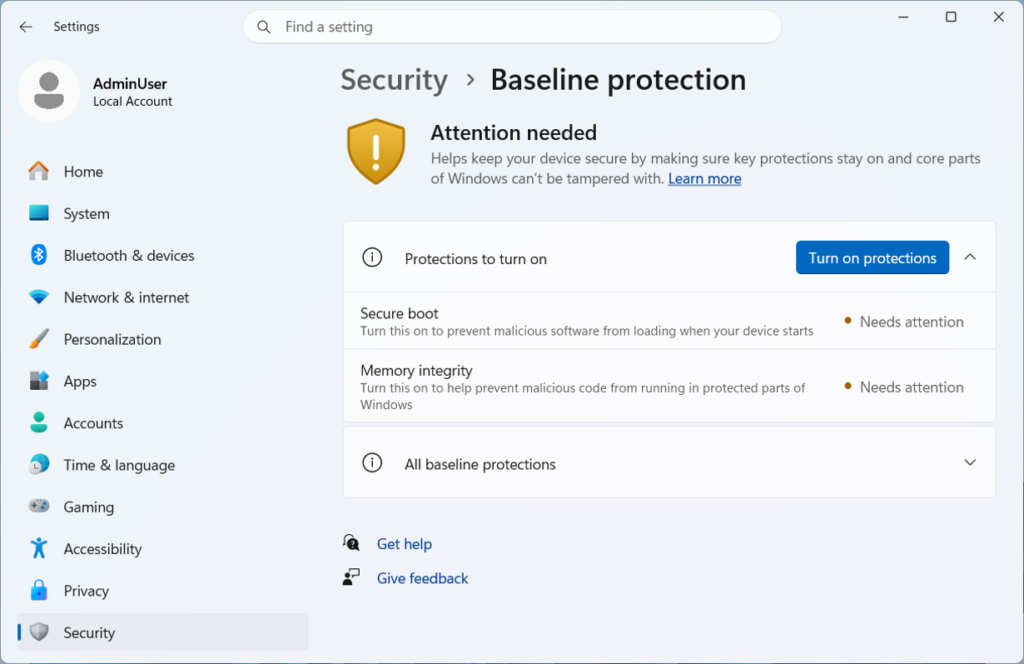
Microsoft also introduced Windows baseline protection, which is now available in preview. This feature groups core protections such as Secure Boot, virtualization-based security, and memory integrity into a single measurable security state. It helps organizations verify whether a device meets a defined security baseline and use hardware-backed attestation when stronger assurance is required.
Microsoft is also preparing customers for future cryptographic threats by expanding post-quantum encryption protections within the Windows TLS stack. New capabilities include pure post-quantum key exchange and authentication technologies intended to help organizations begin the long-term transition toward quantum-resistant security models before practical quantum attacks emerge.
Passwordless authentication and device management get new capabilities
Microsoft announced several updates to Windows Hello, which include a more consistent passwordless sign-in experience and faster desktop access. New observability features will provide administrators with better insight into whether users are authenticating with biometrics or PIN-based credentials.
Microsoft is also expanding Web sign-in support to additional devices and improving security key sign-in experiences, including visual guidance for hardware security key authentication. New security key management capabilities are designed to simplify deployment and ongoing administration.
Microsoft highlighted enhancements to Administrator Protection, which allows users to operate with standard permissions by default and elevate privileges only when necessary. The goal is to reduce risks associated with persistent administrator access while maintaining productivity.
On the management side, Microsoft announced investments in Windows Autopatch, declarative management, and recovery capabilities designed to help organizations maintain compliant configurations and recover more quickly from disruptions. The company also detailed new Microsoft Intune capabilities for application deployment, inventory management, and lifecycle governance.
Microsoft is extending Intune and Windows Autopatch to eligible Windows Server scenarios in preview. This will allow IT teams to manage updates, applications, security settings, compliance, and configurations across both Windows endpoints and supported server environments using a more consistent management model.
New controls aim to bring governance to AI agents
As organizations explore autonomous AI systems, Microsoft says enterprises need mechanisms that ensure agents only perform authorized actions and remain under organizational control. To support that goal, Microsoft is promoting Microsoft Execution Containers, which create policy-governed execution environments for AI agents. These containers are designed to isolate agent activity, enforce access controls, limit interactions with resources and tools, and provide visibility into agent behavior. Microsoft says the technology will help organizations move AI agents from experimentation into production environments while maintaining governance and compliance requirements.
The broader strategy also includes controls around agent identity, containment, isolation, observability, policy enforcement, and governance. Microsoft views these capabilities as necessary building blocks for organizations that want to adopt AI agents without sacrificing security oversight.
What do these changes mean for enterprises?
For enterprise IT leaders, Microsoft’s announcements indicate a shift from endpoint-centric security toward securing an environment where users, devices, applications, identities, and AI agents all operate together. Features such as Windows baseline protection, the Windows endpoint security platform, expanded passwordless authentication, server management through Microsoft Intune, and new AI governance controls could help organizations standardize security controls and improve visibility across increasingly complex environments.
However, organizations may need to modernize identity infrastructure, validate application compatibility with evolving security requirements, adapt operational processes to passwordless authentication, and develop governance frameworks for AI agents. Preparing for post-quantum cryptography is also likely to be a multi-year initiative affecting certificates, applications, authentication systems, and security architectures.
Additionally, tools such as Microsoft Execution Containers may make enterprise AI deployments safer, but organizations will still be responsible for defining permissions, monitoring agent activity, and determining how autonomous systems fit within existing compliance and security policies.

Rabia has a master's degree in Software Engineering and she has years of experience writing professionally about Microsoft products and other technologies. Rabia has also written for OnMSFT.com as well as Windows Report. She is always up to date on t...