Microsoft Adds Multi-Tenant AI and Governance Controls to Microsoft 365 Admin Center
Microsoft is bringing tenant administration, AI agent management, configuration governance, and AI cost controls into a single Microsoft 365 management experience. For organizations operating multiple tenants, the new capabilities could simplify oversight, but they also increase the importance of strong delegated administration and governance practices.

Key Takeaways:
- Microsoft has introduced centralized multi-tenant management capabilities in the Microsoft 365 admin center.
- Administrators can manage AI agents, tenant configurations, and AI spending across connected tenants from a single interface.
- New features include tenant switching, desired-state configuration management, agent governance, and AI cost management.
As organizations expand through acquisitions, regional operations, business-unit autonomy, and managed services relationships, many IT teams find themselves managing dozens or even hundreds of separate Microsoft 365 environments. This challenge has become more complex with the rise of AI, as administrators now have to govern Copilot deployments, AI agents, and consumption-based AI spending across multiple tenants, along with users and policies.
Microsoft has announced new multi-tenant management capabilities in the Microsoft 365 admin center, which give authorized IT admins a centralized location to manage Microsoft 365 environments, AI agents, tenant configurations, and AI consumption across connected tenants. The company says the new capabilities are designed to reduce administrative overhead while helping enterprises and managed service providers maintain governance and operational consistency across distributed environments.
Microsoft brings multi-tenant management to the Microsoft 365 Admin Center
The new multi-tenant management capabilities are available through an All tenants experience in the Microsoft 365 admin center. Microsoft says this service provides a consolidated view of connected tenants and allows administrators to perform management tasks without switching constantly between separate management portals.
This platform focuses on four primary areas, including consolidated tenant administration, cross-tenant AI agent management, configuration standardization and drift remediation, and AI spending visibility and policy management.
The goal is to replace repetitive tenant-by-tenant administration with centralized oversight and governance while preserving tenant-level controls.
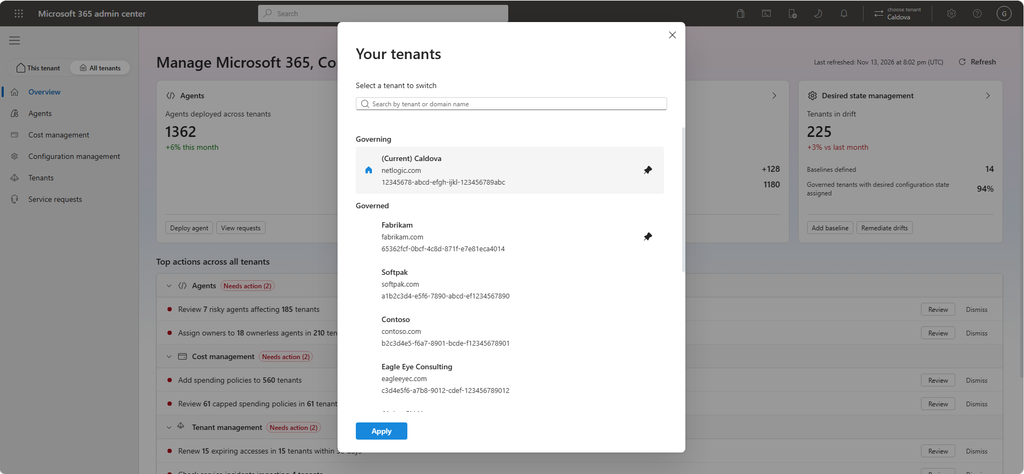
Tenant switching eliminates repeated sign-ins
Microsoft announced that tenant switching is now generally available for commercial customers. This capability allows authorized administrators to move between connected tenants within the Microsoft 365 admin center without signing out, switching accounts, or maintaining separate administrator identities for each environment.
Microsoft emphasized that centralized access does not remove tenant boundaries. Access controls continue to rely on governance relationships and delegated permissions through Microsoft Entra Tenant Governance and Granular Delegated Admin Privileges (GDAP), which ensure IT admins are limited to approved tenants and actions.
Cross-tenant agent governance enters preview
As AI adoption accelerates, Microsoft believes that agent governance is becoming a major management challenge. Administrators need visibility into which agents exist across their environments, how they are configured, and where they are being deployed.
To address this issue, Microsoft introduced multi-tenant agent management, which is now in public preview. This feature allows administrators to view agent inventories across connected tenants, add supported agents to centralized inventories, deploy approved agents across multiple tenants, manage agent settings, permissions, and availability, block agents when necessary, and access agent risk and activity information through Microsoft Agent 365.
Microsoft says this capability is intended to simplify AI governance by providing a single management plane for agent administration while preserving delegated permission models.
New configuration management features target governance drift
Microsoft also introduced desired-state configuration in preview, which is aimed at addressing configuration drift across large tenant estates. The company says changes made by different administrators and business units often cause environments to become inconsistent over time, which makes security and compliance management increasingly difficult.
This new functionality allows organizations to establish baselines using Microsoft-recommended settings or custom configuration standards and apply them across multiple tenants. Administrators can then monitor environments for deviations from those baselines and identify where settings have drifted from approved configurations.
Microsoft says this capability enables enterprises to maintain governance standards centrally while still accommodating regional or business-unit differences. Managed service providers can also use this feature to deliver repeatable configuration-management services across customer environments.
AI cost management brings spending visibility across tenants
As organizations deploy Copilot and AI agents using consumption-based pricing models, Microsoft says tracking usage and controlling costs becomes increasingly difficult when multiple tenants are involved.
To address the problem, Microsoft has introduced AI cost management, which is also in public preview. This feature provides consolidated AI consumption reporting across supported tenants, tenant-level spending drilldowns, reusable spending policy templates, visibility into policy limits and credit requests, and early identification of emerging cost concerns.
Microsoft believes the capability will help organizations move from reactive cost management toward proactive oversight of AI investments across their entire tenant portfolio.
What does centralized tenant management mean for enterprises?
As organizations deploy more AI-powered services, governance challenges are expanding beyond traditional user and device management to include AI agents, consumption-based billing, and configuration consistency across distributed environments.
The new multi-tenant management capabilities could significantly reduce administrative overhead for organizations operating multiple Microsoft 365 tenants. Centralized tenant switching, agent governance, configuration baselines, and cross-tenant cost visibility may help enterprises standardize operations, improve compliance oversight, and deploy AI services more consistently across business units and subsidiaries. Managed service providers could also benefit by creating more scalable service-delivery models across customer portfolios.
However, organizations will still need to establish appropriate governance structures, delegated permissions, and tenant relationships before taking advantage of the platform. The ability to manage agents, spending, and configurations centrally introduces efficiency gains but also increases the importance of role-based access controls and oversight of administrative actions. Enterprises will need to balance centralized governance with the operational autonomy often required by regional businesses, subsidiaries, and individual customer environments.

Rabia has a master's degree in Software Engineering and she has years of experience writing professionally about Microsoft products and other technologies. Rabia has also written for OnMSFT.com as well as Windows Report. She is always up to date on t...