Reclaim.AI: Why Intelligent Calendars Are Finally Gaining Ground
How Reclaim AI is reshaping time management for professionals who’ve hit the scheduling wall.

“I ate lunch five times this week for the first time in two years.”
This unlikely customer quote captures what makes Reclaim AI feel revolutionary. It isn’t that it adds something new to your calendar — it’s that it makes your existing one finally work the way it should.
Reclaim, founded by Henry Shapiro and his co-founder during their time at New Relic, was born from a shared Sunday night ritual: “We both realized we had the same exact Sunday night — sitting down at our desk and going through our calendar for the week trying to just like get it under control,” Shapiro recalled.
What started as a pain point has evolved into an intelligent calendar assistant platform now deployed across 60,000 companies with over 300,000 users.
Calendars aren’t broken — but our lives are
Reclaim doesn’t replace calendar platforms like Google or Outlook. Instead, it layers intelligence on top of them. “We sort of bring intelligence and automation into that system,” Shapiro explained, “letting you express what your preferences are, what your priorities are, and then the system takes care of all the scheduling and rescheduling.”
This philosophy gave birth to features like Calendar Sync, designed to keep work and personal schedules from colliding. “The very first feature we launched was syncing events across calendars — because nobody wants their boss to see the title of their personal doctor appointment.”
From lunch to life management
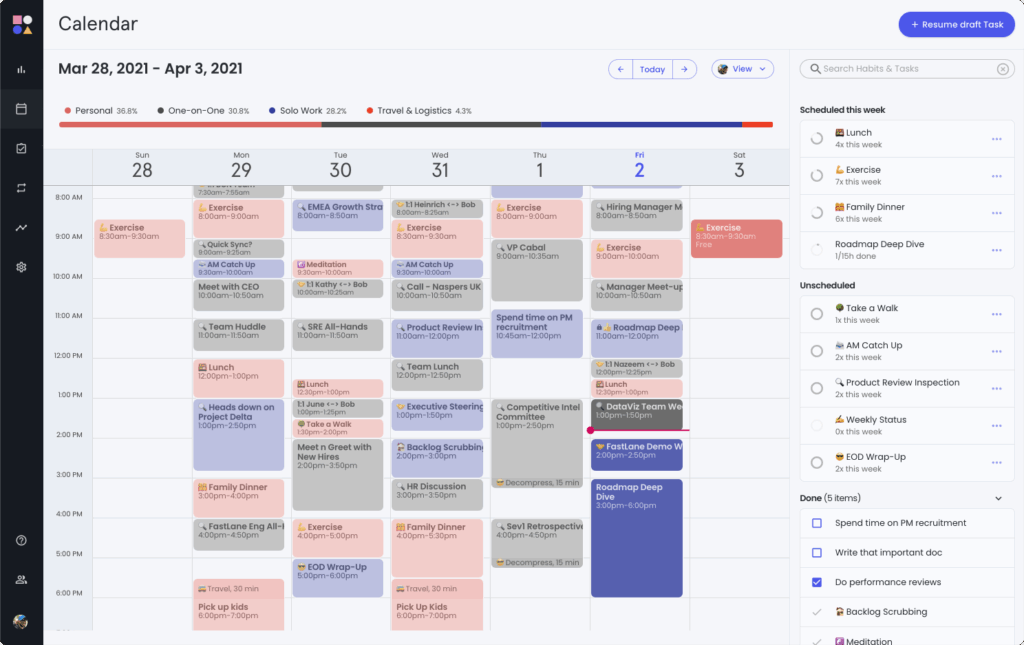
The early version of Reclaim focused on simple use cases. “We started with: how do we make time for lunch and email?” That functionality expanded into Habits — flexible, rule-based routines that adapt based on your availability.
Instead of rigid time blocks, Reclaim lets users set boundaries and priorities. Lunch, for example, can be set to occur anywhere between 11:30 AM and 2 PM, and Reclaim dynamically schedules it. “We adapt,” said Shapiro. “People told us, ‘I ate lunch five times this week for the first time in years.’ That’s shocking.”
And it’s not just about food. Reclaim’s AI-based prioritization engine handles competing demands across tasks, habits, and meetings — turning calendars into intelligent agents.
Reclaim.AI cracks the Outlook code
Launching first with Google Workspace, Reclaim’s expansion to Outlook wasn’t just strategic — it was an engineering Everest.

“We had to basically decouple all of our Google-specific bindings and build an entirely new event pipeline,” said Shapiro. That meant facing nuanced differences, like notification handling. “Google lets us suppress event notifications. Microsoft doesn’t — so we had to build in resiliency to prevent notification spam.”
Yet despite the pain, he praised Microsoft’s ecosystem: “Their APIs are better documented, and the developer experience is arguably more mature than Google’s.”
Smart meetings, smarter scheduling
While tools like Calendly and Outlook’s Scheduling Assistant require manual coordination, Smart Meetings in Reclaim take a different approach. They automatically reschedule recurring one-on-ones and team meetings if conflicts arise, aligning with personal preferences, availability, and even time zones.
“If I’m on vacation and miss our Tuesday 2 p.m., Reclaim will find the next best time for us — without 15 emails going back and forth.”
One-off meetings are handled via scheduling links that consider task priority, enabling users to offer more availability without exposing critical calendar events.
Prioritizing the unprioritized
One of Reclaim’s differentiators is its understanding of context and tradeoffs. Whether it’s lunch, a team sync, or a looming deadline, users can assign importance levels to events. “Calendars are just a dumb database,” Shapiro noted. “We bring in the intelligence to understand what matters more.”
This prioritization spills over into Reclaim’s task management system, which intelligently schedules time for work based on urgency, estimated duration, and deadlines. “We integrate with Asana, Todoist, Jira, Google Tasks, and more — automatically updating work logs and reflecting task progress across systems.”
Is AI ready to run your calendar?
Not quite — at least, not fully. While Reclaim is exploring deeper AI integrations, they’re proceeding with caution. “People want predictability in their calendars,” Shapiro emphasized. “AI models are powerful, but they’re inherently non-deterministic — and that doesn’t fly when you’re trying to plan your day.”
Instead, Reclaim’s current intelligence is mostly algorithmic, with future opt-in GenAI features that preserve privacy and tenant isolation.
What about Microsoft Copilot?
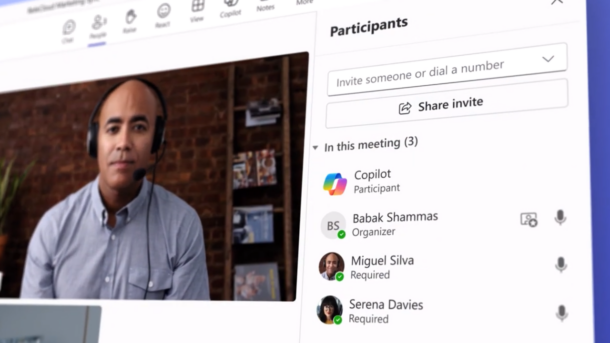
Microsoft’s Copilot promises calendar enhancements — but so far, Shapiro isn’t impressed.
“They’ve been talking about smart scheduling with Planner and Tasks, but I haven’t seen it show up yet,” he said. “Just getting basic scheduling automation to work is incredibly hard. We’ve been at it for six years.”
The infrastructure, not the AI, is where the real work lies.
Pricing, adoption, and the human right to lunch
Reclaim offers a free tier with core features, including Calendar Sync and limited routines. “We believe calendar sync is a human right,” Shapiro joked. Paid tiers unlock deeper customization, unlimited integrations, and enterprise features.
While some users need support onboarding, many dive in with just a few clicks. “Sometimes people pick it up in 30 seconds. For others, it takes weeks. But our team is always available — I’m even in the support chat myself.”
A weather forecast for dog walkers?
One of my feature requests caught Shapiro off guard — weather-aware scheduling for daily dog walks. He laughed, but admitted: “That’s actually one of the more popular requests. We’re actively looking into more external context — travel time, weather, location — to make Reclaim even smarter.”
Final thoughts
Reclaim AI doesn’t try to solve every problem. It solves the biggest one: how to make time for what matters. Whether that’s a dog walk, a project deadline, or yes — finally eating lunch.
Watch the full interview with Henry Shapiro on Petri.com.

Russell Smith, the Editorial Director at Petri IT Knowledgebase, has over two decades of hands-on experience in IT, in both small business settings and government IT infrastructure projects. Russell started writing for Windows IT Pro Magazine in t...