Azure Local SAN Support – A Necessary Feature or a Thing from the Past?
A fresh look at why SAN integration matters for Azure Local customers today.

Key Takeaways:
- Azure Local SAN support enables customers to reuse existing Fibre Channel investments when adopting Azure Local.
- The feature reduces hardware acquisition costs by allowing smaller server configurations with external SAN storage.
- Organizations moving away from VMware gain a clearer migration path without sacrificing current infrastructure.
- The addition of SAN support expands Azure Local’s applicability beyond edge deployments into traditional datacenters.
Before diving in, consider how this feature reshapes Azure Local deployments in real-world datacenters.
Understanding Azure Local SAN support
Azure Local SAN support (Storage Area Network) represents a significant shift in how customers can architect Azure Local environments. Today I want to dive deeper into the SAN support for Azure Local, as announced by Microsoft in preview in November 2025 through their update on what’s new in Azure Local and Azure Arc-enabled cloud infrastructure for distributed locations.
Curious how this compares to earlier platform generations?
Back in the days with Azure Stack (before Azure Stack HCI) and Windows Server, Microsoft supported both converged and hyper-converged deployments.
This meant deployments using SAN storage in a converged architecture were supported, as well as hyper-converged deployments where everything resided within the same server.
With Azure Stack HCI, which was later renamed to Azure Local, SAN support was removed from the deployment pattern. While I worked at Microsoft over the past four years, I often received requests from customers to bring back SAN support.
Many of these customers wanted to use Azure Local in their datacenters rather than exclusively at the edge of their networks. These organizations had existing Storage Area Networks, either based on iSCSI or Fibre Channel, and wanted to preserve their investment and operational knowledge. At that time, it was not possible to deploy Azure Local in a converged architecture.
Even when technically possible, it remained unsupported. This limitation existed because Microsoft aimed to provide a controlled platform for hybrid services deployed from Azure. These services include:
Supported Azure hybrid services
| Azure hybrid service | Description |
|---|---|
| Azure Kubernetes Services | Managed Kubernetes environment integrated with Azure Arc |
| Azure Virtual Desktop | Virtual desktop infrastructure deployed in Azure Local |
| Azure Virtual Machines using Azure Arc | Arc-managed virtual machines running in Azure Local |
The controlled platform was necessary to ensure a compatible and fully supported environment for these Azure services.
How Azure Local SAN support expands deployment options
What does this new capability unlock for customers migrating or modernizing datacenter workloads?
With the announcement in November, the ecosystem now grows toward supported SAN solutions, primarily through Microsoft partners known for delivering Azure Local appliances.
The SAN support currently covers only Fibre Channel storage. Customers now have the option to deploy and modernize their hypervisor environments or migrate off VMware toward Azure Local without abandoning their SAN investments.
This step significantly reduces investment costs for customers who already own Fibre Channel SANs. Organizations no longer need servers with large numbers of disks or flash storage. They can instead purchase smaller servers—for example, moving from 2U servers to 1U servers while retaining the same memory and CPU capacity.
Hardware comparison table (impact on deployment costs)
| Item | Previous requirement (without SAN support) | New option (with SAN support) |
|---|---|---|
| Server model example | Dell APEX Cloud Platform MC-760 (high disk count) | Dell APEX Cloud Platform MC-660 (same CPU/RAM, fewer disks needed) |
| Storage dependency | Local disks required for HCI storage | External Fibre Channel SAN provides storage |
| Rack usage | Typically 2U servers | Option to downsize to 1U servers |
| Cost impact | Higher hardware acquisition and power consumption | Reduced hardware, energy, and cooling costs |
You can explore these offerings in the Dell-powered Azure Local Solutions catalog.
The image below visualizes this impact for customers.
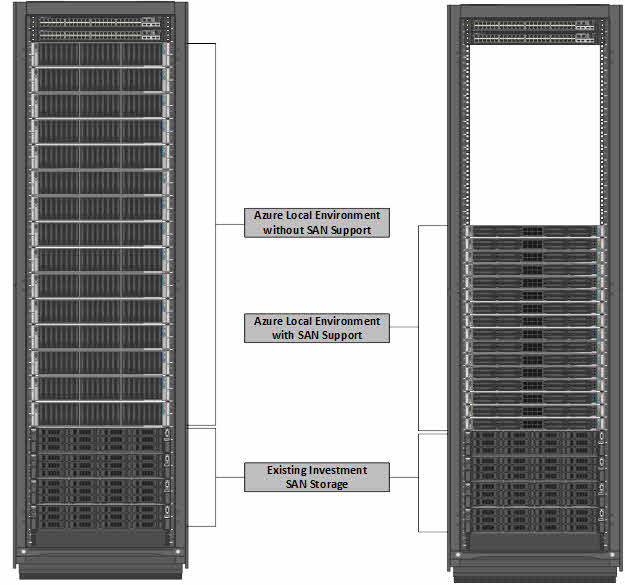
Reduced hardware also lowers cooling and energy costs in customer datacenters. A helpful reference is the analysis from ServeTheHome comparing power usage in 1U versus 2U server configurations.
Another good perspective comes from IT Parts 123, who provide guidance on choosing between 1U and 2U rackmount servers.
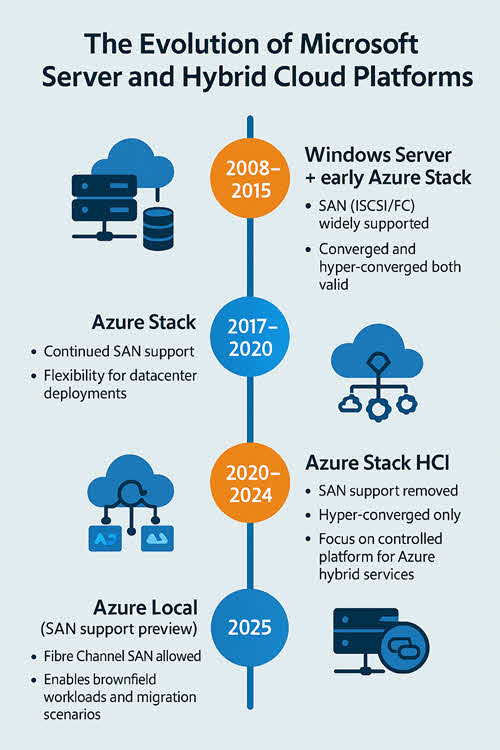
The evolution of SAN support in Microsoft hybrid infrastructure
How did we get from hyper-converged only to SAN support re-emerging in Azure Local?
Below is a simple timeline showing the progression of SAN support across Microsoft’s hybrid platform generations.
Conclusion
Supporting Fibre Channel Storage Area Networks is a major step toward enabling brownfield and classic datacenters to use Azure Local for deployment, migration, and modernization plans. Customers who want to migrate off VMware and maintain their investments in Fibre Channel infrastructure now have an additional option.
Frequently asked questions
Why does Azure Local only support Fibre Channel SANs and not iSCSI?
Azure Local currently limits SAN support to Fibre Channel to ensure predictable performance, reliability, and alignment with certified partner hardware. Fibre Channel environments also offer more consistent latency profiles, which are essential for Azure Local’s hybrid workloads.
Can Azure Local SAN support be used for all workloads?
SAN storage can be used for most virtual machine workloads that meet Azure Local’s requirements. Some Azure services still require specific architectures, so customers should validate configuration details in Microsoft’s documentation.
Does SAN support change the underlying Azure Local clustering model?
No. The platform remains hyper-converged for control plane components. SAN support applies to VM storage but does not modify how Azure Local manages its internal cluster resiliency.
Is SAN support intended for edge locations or traditional datacenters?
SAN support broadens Azure Local’s appeal beyond edge deployments, enabling more traditional enterprise datacenters to adopt the platform while preserving existing Fibre Channel investments.

Flo Fox spend nearly 10 years with Microsoft as Sr. Engineer and Priority Area Lead at Microsoft before leaving the company in 2025. Currently he is working as a Area Lead for Infrastructure at itacs GmbH (itacs – Einfach leicht machen.) in Germany...