Your AD Domain Controller Could Be a Goldmine for Hackers
Cybercriminals are shifting to highly targeted attacks by exploiting Domain Controllers—putting entire enterprise networks at risk.

Key Takeaways:
- Cybercriminals are increasingly targeting AD Domain Controllers to launch ransomware attacks.
- A single breach can grant attackers high-level access to spread malware quickly.
- Microsoft and NSA recommend layered security strategies to protect critical systems.
Microsoft has warned that cybercriminals are increasingly targeting Active Directory (AD) Domain Controllers to launch sophisticated ransomware attacks. By compromising these critical servers, attackers gain high-level access, allowing them to spread ransomware across entire enterprise networks rapidly.
🎬 Watch This Week in IT.
A domain controller is a specialized server in a computer network that manages user identities, authentication, and access to resources within a domain. It stores and enforces security policies, verifies login credentials, and ensures that only authorized users can access specific systems or data. Domain controllers play an important role in maintaining the integrity and functionality of enterprise IT environments.
How hackers infiltrate and exploit Domain Controllers?
In a recent blog post, Microsoft highlighted that ransomware has evolved from opportunistic attacks to highly targeted, human-operated campaigns. These attacks aim to cripple entire organizations quickly to receive ransomware payments from the victim.
Domain controllers are important for identity and access management in on-premises environments. However, they are prime targets because compromising them allows attackers to gain high-privileged access and spread ransomware rapidly across the enterprise network.
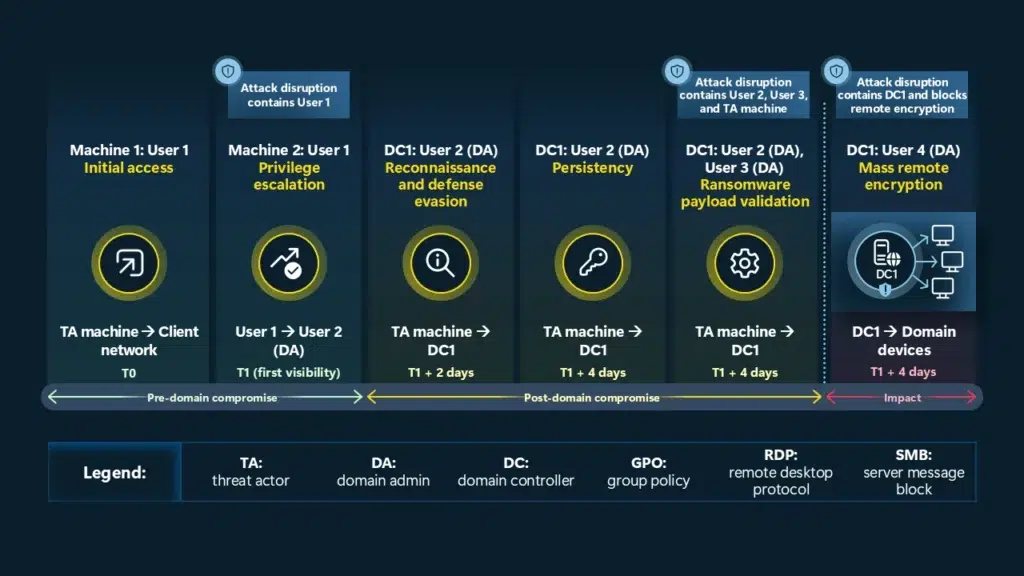
Typically, cyberattackers follow a multi-stage strategy to target domain controllers with ransomware. Attackers begin by infiltrating the network and remain undetected while they explore the environment. The primary goal is to gain access to high-privileged accounts, which allow them to authenticate across the network.
Once the hackers steal the credentials, they aim to compromise central assets like domain controllers that manage access to most devices. The cybercriminals then rapidly deploy ransomware across various systems simultaneously. This technique helps them to maximize disruption and increase the likelihood of getting ransomware from the victim.
Best practices to protect your organization
Microsoft recommends that organizations should use a multi-layered defense strategy to protect domain controllers from ransomware attacks. Administrators must secure privileged accounts by using strong authentication methods. They should also monitor domain controller activity closely to detect unusual behaviour within their enterprise network.
Microsoft also emphasizes the importance of network segmentation, regular patching, and restricting internet access from domain controllers to reduce exposure. Moreover, organizations should use tools like Microsoft Defender for Endpoint to automatically detect and disrupt ransomware activity.
The National Security Agency has also detailed a couple of best practices, such as implementing Tiered Administrative Models, enforcing Least Privilege principles, and conducting regular Active Directory hygiene assessments, such as monitoring service accounts and auditing privileged groups.

Rabia has a master's degree in Software Engineering and she has years of experience writing professionally about Microsoft products and other technologies. Rabia has also written for OnMSFT.com as well as Windows Report. She is always up to date on t...