Windows 11 Gets Wi-Fi 7 Enterprise Support to Boost Security and Performance
Wi-Fi 7 support arrives on Windows 11 to boost enterprise speed, security, and reliability.

Key Takeaways:
- Microsoft extends Wi-Fi 7 support from consumers to enterprise environments with Windows 11 version 24H2.
- New features improve security, roaming, and connectivity in high-density workplaces.
- Performance upgrades enable faster, more stable connections for demanding applications.
Microsoft has rolled out support for Wi-Fi 7 enterprise access points for Windows 11 version 24H2 devices. This update brings enhanced speed, reliability, and security to meet the growing connectivity demands of modern enterprise environments.
Microsoft introduced Wi-Fi 7 support for consumer access points in 2024. The consumer-focused launch allowed hardware vendors and software developers to refine compatibility and performance.
“The performance enhancements introduced by Wi-Fi 7 in the consumer space are now being extended to enterprise environments. Wi-Fi 7 for enterprise is designed to address evolving security needs while helping support reliable connectivity in high-density, high-throughput scenarios,” Microsoft explained.
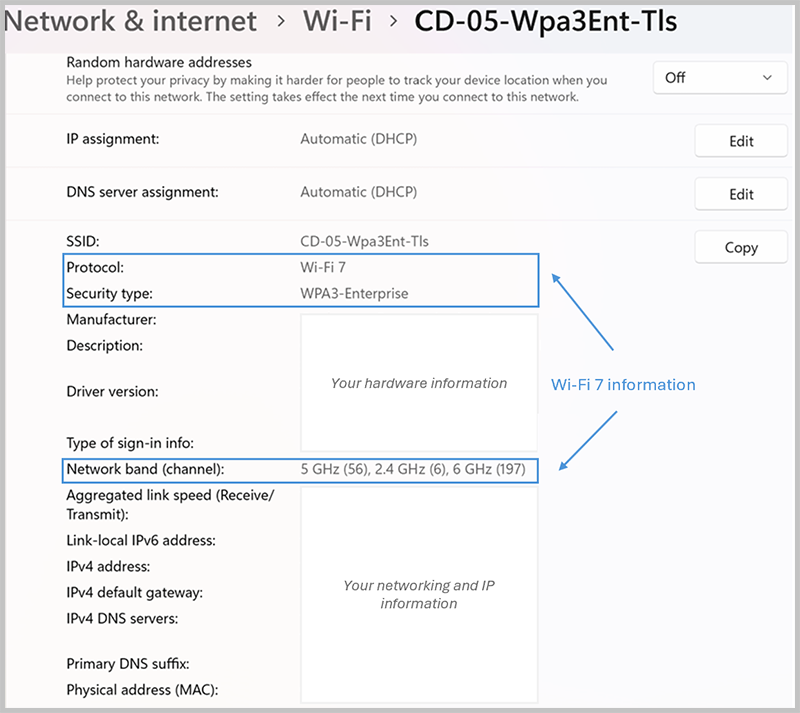
Stronger security with WPA3-Enterprise authentication
Microsoft mentioned that Wi-Fi 7 introduces WPA3-Enterprise authentication as a mandatory security standard for enterprise networks. This protocol strengthens protection by using advanced encryption methods and safeguarding against brute-force attacks. It also ensures that sensitive data remains secure across devices and access points within enterprise environments.
Seamless roaming for always-on connectivity
Another major enhancement is seamless roaming capabilities, which enhance user experience in environments with multiple access points. Microsoft says that technologies like Opportunistic Key Caching (OKC) and 802.11r Fast Transition (FT) allow devices to switch between access points without noticeable delays or re-authentication. This capability is particularly useful in large office spaces, hospitals, or campuses where uninterrupted connectivity is required for real-time applications.
Performance boosts
Wi-Fi 7 enterprise also provides significant performance improvements. It supports Multi-Link Operation (MLO) that enables devices to use multiple frequency bands simultaneously for faster and more stable connections. The use of 320 MHz channels in the 6 GHz band and 4096-QAM modulation boosts data throughput and reduces latency. This makes it ideal for demanding applications like video conferencing, AR/VR, and cloud computing.
Enterprise deployment requirements for Wi-Fi 7
To deploy Wi-Fi 7 support in an enterprise setting, organizations must meet four key prerequisites. First, devices must be running Windows 11 version 24H2 with the latest updates to support the new standard. This feature also requires Windows devices with Wi-Fi 7-capable chipsets.
Last but not least, these Windows 11 devices must have certified Wi-Fi 7 drivers provided by OEMs or hardware vendors. Administrators must also deploy Wi-Fi 7 enterprise-grade access points within their organizations.

Rabia has a master's degree in Software Engineering and she has years of experience writing professionally about Microsoft products and other technologies. Rabia has also written for OnMSFT.com as well as Windows Report. She is always up to date on t...