Microsoft Expands Purview Data Protection and Governance Capabilities in Microsoft Fabric
Microsoft strengthens Fabric with new Purview capabilities to secure data, govern AI usage, and reduce oversharing risks.

Key Takeaways:
- New Microsoft Purview updates tighten security and governance within Microsoft Fabric
- Expanded controls help reduce AI-driven data exposure risks
- Added oversight improves visibility into data usage and quality
Microsoft has announced new Purview enhancements for Microsoft Fabric at FabCon Atlanta, aimed at making enterprise AI adoption more secure and controlled. The updates strengthen data protection, governance, and quality, and help organizations scale AI initiatives without increasing risk across their data estates.
Microsoft Fabric is an all‑in‑one data and analytics platform that brings together data integration, engineering, warehousing, science, real‑time analytics, and business intelligence in a single, unified environment. It’s built on a shared data foundation called OneLake, and lets organizations work with data in one place, reduce complexity, and more easily power analytics and AI solutions across the business.
Stronger protection against data oversharing in Fabric
Microsoft emphasized that AI adoption increases data exposure risks. Microsoft Purview now extends several security capabilities directly into Fabric workloads, including Data Loss Prevention (DLP), Insider Risk Management (IRM), and Data Security Posture Management (DSPM).
Expanded DLP and insider risk controls
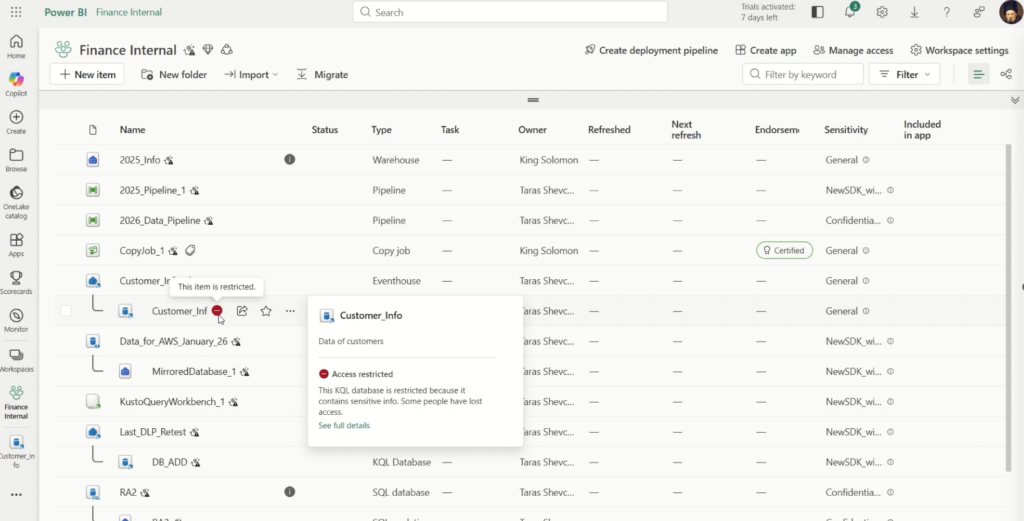
Microsoft has introduced new features that let administrators apply DLP policies to Fabric Warehouses and KQL/SQL databases, which trigger policy tips or restrict access when sensitive information is detected. Moreover, Insider Risk Management now covers Fabric lakehouses, which allow organizations to identify risky behaviors such as external sharing or data exfiltration.
Governance of AI interactions in Fabric
Microsoft Purview also helps to protect Copilots and AI agents in Microsoft Fabric. This release brings new preview capabilities to help organizations detect sensitive data in AI prompts and responses, assess oversharing risks, and investigate unsafe AI usage. These features are supported by existing Purview tools such as Audit, eDiscovery, and retention policies.
Improved data governance and quality via the Unified Catalog
Last but not least, Microsoft has also rolled out several improvements to data governance and trust. The Purview Unified Catalog provides organization‑wide data discovery and includes publication workflows for data products and glossary terms. Microsoft has also expanded data quality checks, which allow security teams to assess and improve data, even for ungoverned assets.

Rabia has a master's degree in Software Engineering and she has years of experience writing professionally about Microsoft products and other technologies. Rabia has also written for OnMSFT.com as well as Windows Report. She is always up to date on t...