What is IP Subnet Zero? – Cisco Articles & Tips
I am sure you have used the Cisco IOS command show running-config before, and noticed a peculiar default command in the configuration. The command I am talking about is ip subnet-zero. Here is what I am talking about: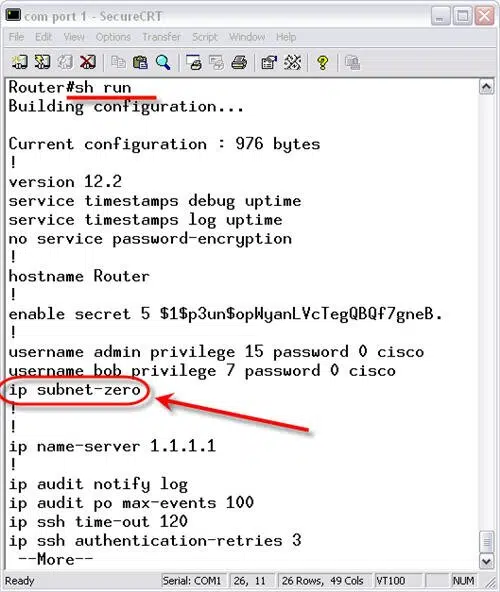
But what is this command? Why is it there? Let’s find out.
What is a zero subnet in the first place?
Before we talk about the command, let’s ask ourselves, “In the first place, what is a zero subnet?” Under old IP subnetting rules, the all 0’s subnet was reserved for the network, and the all 1’s subnet was reserved for the broadcast. Over time, engineers found that the all 0’s subnet wasn’t really used and, if it could be handed out as a usable network, many IP addresses could be changed.
An example of an IP address that is using a zero subnet is 10.1.0.1 with a subnet mask of 255.255.255.0. This IP address may look pretty weird to you. Some people may even try to argue that it is an invalid IP address because there is a 0 in the third octet. However, today, this IP address is perfectly legal when it comes to subnetting. Thus, if I had an IP address of 10.1.0.0 with a 255.255.0.0 subnet mask and wanted to subnet it, I could actually get 255 valid networks out of it by using the 0 subnet. In other words, I could have networks ranging from 10.1.{0-254}.X where the X represents hosts 1-254. This gives me room for networks 0-254, or 255 total networks, by using the 0 subnet.
Do I need to enable my router to recognize the zero subnet?
The quick answer to this question is NO. Your Cisco IOS router, by default, has the command ip subnet-zero enabled on the router. Because of this command, the zero subnet can already be recognized.
Do I really want to use the ip Subnet zero feature?
Just because something is there, doesn’t mean you should use it. That is true in the case of the zero subnet. Because many people still believe that the zero subnet is not a legal subnet, I would avoid using it if possible. I would do this just to avoid confusion when it comes to network configuration. On the other hand, if you work for a large Internet Service Provider and are handing out blocks of IP addresses, I would definitely hand out the zero block to help conserve your IP address resources.
Summary
In this article, we learned the difference between the following 3 commands:
- ip default-gateway
- ip default-network
- ip route 0.0.0.0 0.0.0.0 (configuring a default route)
The default-gateway command should only be used when a router is functioning as a bridge. The ip default-network and ip route 0.0.0.0 0.0.0.0 commands should be used to tell the router what route to select as the “gateway of last resort”.
FAQs
How does ip subnet zero impact network security in Cisco devices?
IP subnet zero can potentially increase security risks if not properly configured, as it expands the available address space that needs to be monitored and protected. It’s recommended to implement strict access control lists (ACLs) and use proper network segmentation when utilizing ip subnet zero in production environments.
Can ip subnet zero be used with IPv6 addressing?
No, ip subnet zero is specifically designed for IPv4 addressing schemes. IPv6 uses a different addressing structure and doesn’t require the concept of subnet zero due to its vast address space and different subnetting mechanisms.
What are the performance implications of enabling ip subnet zero on large networks?
Enabling ip subnet zero generally has minimal impact on network performance, as modern routers handle the additional subnet calculations efficiently. However, it may slightly increase routing table sizes and memory usage when implemented across large-scale networks.
How does ip subnet zero interact with VLSM (Variable Length Subnet Masking)?
IP subnet zero works seamlessly with VLSM implementations, allowing network administrators to utilize the zero subnet within variable-length subnet designs. This provides greater flexibility in network planning and IP address allocation when using VLSM strategies.
Are there any specific troubleshooting considerations when using ip subnet zero?
When troubleshooting networks using ip subnet zero, administrators should pay special attention to legacy devices that might not support zero subnets, verify subnet calculations carefully, and ensure routing protocols are correctly configured to recognize and advertise zero subnet networks.

Renowned as the creator of the acclaimed Petri IT Knowledgebase back in 1999 Daniel Petri has become a distinguished figure in the IT realm, recognized for delivering reliable, expertise-driven content. This website - www.petri.com - not only embodie...